
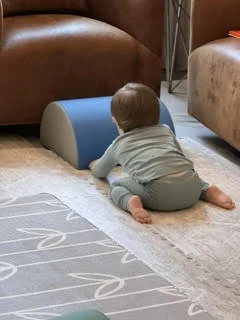
Parents often call me because they are worried about a milestone.
“My baby isn’t rolling yet.”
“She isn’t sitting on her own.”
“Everyone keeps asking if he’s crawling.”
Milestones are important. They provide a general framework for development and can help identify when a child may need additional support. But when I evaluate a baby, I am looking at far more than whether a milestone has been achieved. In many ways, how a baby moves is just as important as when they move.
Two babies may both be sitting independently. One may move easily in and out of sitting, rotate to reach for toys, shift weight from side to side, and use a variety of movement strategies throughout play. Another may sit by holding their body stiffly, avoiding rotation, and struggling to transition into or out of the position. On paper, both babies have achieved the milestone of sitting. Clinically, they may present very differently.
During an evaluation, I spend a great deal of time observing movement quality.
I look at symmetry. Is the baby using both sides of their body equally? Do they turn their head comfortably in both directions? Is weight distributed evenly through the arms, legs, and trunk? Asymmetries can sometimes provide important clues about muscle tightness, weakness, positioning preferences, or underlying motor challenges.
I look at postural control. A baby’s ability to maintain and adjust their posture forms the foundation for future movement skills. Before a baby can crawl, stand, or walk, they must learn how to control their body against gravity. Postural control influences everything from reaching for a toy to maintaining balance during movement.
I look at weight shifting. Movement is a series of controlled weight shifts. Rolling requires weight transfer. Crawling requires weight transfer. Walking requires weight transfer. Babies who struggle to move their weight from one side of the body to the other often compensate in creative ways that can affect future skill development.
I pay close attention to transitions. Can the baby move between positions? Can they get into sitting, out of sitting, onto their tummy, or back onto their back? Development is not simply about maintaining a position. It is about learning how to move between positions with control and confidence.
I observe rotational movement. Human movement rarely occurs in straight lines. Rolling, crawling, reaching across the body, climbing, and walking all rely on rotation. Babies who prefer to move only in extension or only in straight planes may benefit from activities that encourage a wider range of movement experiences.
I also evaluate balance strategies. What happens when the baby loses their balance? Do they attempt to recover? Do they use their arms for protection? Do they explore movement or avoid it? These responses provide valuable information about motor planning, body awareness, and confidence.
Equally important is the baby’s interaction with their environment.
Are they curious? Do they explore? Do they move toward toys and people? Do they attempt to solve movement challenges on their own? Play and exploration are powerful motivators of motor development and often tell me as much as the physical examination itself.
Perhaps most importantly, I look at the whole child. Development is not a checklist. Every baby brings their own temperament, strengths, preferences, experiences, and challenges. My goal is not simply to determine whether a milestone has been reached. My goal is to understand the movement patterns that are supporting development and identify any barriers that may be getting in the way.
Milestones matter. But the story is often found in the spaces between them.
As pediatric physical therapists, we are trained to look beyond the checklist and examine the quality of movement, the foundations beneath the skills, and the patterns that shape future development. When it comes to motor development, how a baby moves matters just as much as when they move.